
A few years ago I joined a cycling group so I could become a stronger, safer rider. For me that meant comfortably doing 5-15 mile rides tooling around Bainbridge Island without having to walk my bike up hills.
From the very first ride I got my butt kicked, but good. I soon discovered that I was in the midst of a group of seriously competitive cyclists. They were interested in safety, yes, but safety in the context of 30-100 mile rides at averages upward of 20 miles per hour. Including hills.
Perhaps because the coach was a friend, and I wanted to support his business, I kept showing up. Within a year I was a full-fledged member of the Bad Princesses.
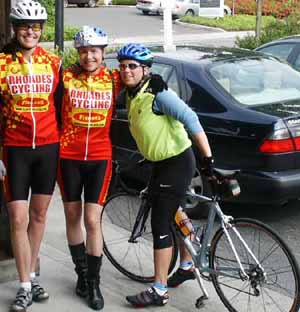
[That's me in the center, celebrating my 50th birthday as a Bad Princess with black boots and a paper tiara. Our coach was appalled.]
Very quickly, my goal dropped away
My initial goal had nothing to do with sticking with the group, and I didn’t replace it with a new one. In fact, the very idea of setting a cycling goal gave me the heebie-jeebies. I just wanted to survive the next ride.
And it turns out that there’s evidence that past a certain point focusing on the goals you set stops being helpful.
How goals work for and against you
Last year a study by Ayelet Fishbach and Jinhee Choi of the University of Chicago School of Business showed that:
* Setting goals is a good way to motivate yourself to adopt the activities and practices that will help you reach them.
* Focusing on a goal after you’ve begun working toward it tends to reduce your enjoyment of and motivation to continue those same activities and practices.
* Focusing on the in-the-moment experience of those activities and practices increases enjoyment and motivates you to continue them.
Enjoying the process is the secret to making a profit
I’m a strong proponent of setting goals in your business. Setting goals focuses your attention and intentions so that you know where you are headed. Goals can be good motivators for starting projects that will make you profitable, and they are useful reference points.
But after your goals are in place, it’s best to shift your focus to the in-the-moment activities and practices of getting where you want to go.
And to cultivate joy in mundane matters such as marketing, getting organized, and selling.
How to cultivate joy in the mundane
Okay, joy may be a stretch, at least at first. But it is entirely possible to find satisfaction and engagement in the mundane activities and practices that will make your business profitable.
One way to do that is to turn daily tasks into meditation along the lines of “Chop wood, carry water.” Break projects down into tiny actions. As best you can stay in the moment as you complete each action.
See if you can expand into the present moment rather than hunker down when you answer email, balance your checkbook, or–heaven forfend–write sales copy.
I’m not saying you should aim to make every moment you spend on your business a peak experience. Just invite instances of ease. Lean into times when you feel good about something you’ve accomplished.
Build on those moments when you are surprised by happiness in the midst of what might be otherwise tedious.
In time the goal and the experience come together
In the course of a year, a new cycling goal did emerge for me. I wanted to feel fabulous. I wanted to feel the way I felt when I had challenged my mind and body to the utmost. I wanted to feel the way I felt when I became one with my teammates.
You could say that my goal and the experience of working toward the goal had become one and the same.
That happens in our businesses when we let down the barrier between how we show up for the work we love and how we show up for the business that supports that work. When we drop the story that we have to be one kind of person in the work we do and another kind of person when we do the business part.
This week see if you can allow feelings of lightness, engagement, and happiness to carry over into the mundane tasks of earning a profit. Think small. Think happy.
Enjoy.

Love your comments about goal setting. Recently I joined a group “BraveHeart Women” as a Resonator and one of the things we did was set our intentions for each of our purposes (personal, professional and global), nine each, twenty seven for the beginning of December. As the month progressed we determined the essence, combined, reduced and refined. By the time January came along they had become part of my psyche and I have not looked at them since. They have however helped me focus on what is necessary to push toward my desires. I am back painting on a regular basis and the circumstances are no longer part of the equation. Love it!
Karen–That sounds like a very valuable goal-setting or intention setting process. Thank you for sharing it. And I love that you are back painting!
My new words to live by-” Cultivate joy in the mundane”- thank you!
Oh my goodness. What a helpful distinction — to start with goals, establish them, then really get into the practices. This makes so much sense and really seems to resonate with real life. (Love your examples/story!) I’ve wondered why goals seemed so toxic to me…More resonant for me have been the positive practices. Now there’s a path to a happy marriage between them! As always, good wisdom and insights and lots to chew on. Thank you Molly!
I love it, too, Bobbye. Goal setting can be such a bugaboo. Valuable and not, depending on when and how we employ it.
I like this approach, Molly. And it makes sense. If you’re focused on the activities and practices themselves and making progress, it builds momentum, which is a much-overlooked but very powerful source of energy for more action.
However, couldn’t it also work to set “stretch goals” – big visions of what you truly want to create, and then, after grounding them in the reality of where you are and what you have to work with, you set smaller, realistic, “benchmark goals?”
This is what many (most?) atheletes do. The envision world championships and Olympic medals. Those stretch goals set the context and help set up an energizing creative tension when held in mind with vision. Then, starting with their current reality they set and focus on small goals such as beating their personal best, making the team, qualifying for regionals, nationals, etc…
I think you can do this kind of thing and be fully immersed in the moment.
I also think that folks should pick an approach that works for them. So, the more options, the better. Eh?
Cheers!
Bruce
“Being fully immersed in the moment” is the key. What the research showed is that being reminded of the goal when doing the activity took away from engagement and motivation. Remembering the goal from time to time to evaluate progress can, I think, be valuable. For one thing, it gives you an opportunity to celebrate. For another, it gives you what you need to know to correct your course, if necessary.
Thanks for adding to the goal setting conversation, Bruce!
What a breath of fresh air! So many times I’ve heard the idea that the I need to wear my “business hat” at times, and my “creative hat” at others. This thought has often kept me from finding the joy in networking, marketing, and customer service. I love the idea that I can be a creative at all times, and find ways to bring my authentic love to all of my tasks. The “carry water” as meditation mantra is a great one. Thanks for the inspiration today! Very timely for me.
Yay! I love imagining you rocking the world as you bring your creativity to all your business activities. ♥
Hi Molly, I thought this was an excellent article. Both from the coaches perspective and as a business owner I can agree totally totally with what you say. I’m going to be even more present to the small feelings of joy in the mundane business parts. “Invite instances of ease.” The mantra of a CranioSacral Therapist. LOL
)
It’s a good mantra, isn’t it!
Don;t know if I can leave anything new that others haven’t already mentioned. Thanks for the post. It’s quite relevant for me too. I’ve noticed that pattern, I set the goal and then somewhere along the way I lose the moment or the interest in the goal. I have however, been working with a coach and I notice we set a lot of goals in 2012 that I’ve accomplished. We wrote the goals talked about them, did affirmations around them and let them go. And lo and behold most if not all of them came to fruition.
Thanks Again!
Hi Edna,
Thank you for sharing your experience with goal setting. I think everyone has something valuable to add to the conversation. I, too, find that setting goals is very valuable, as is exploring those goals with someone like a coach or mastermind group. After that, it’s all about engaging fully in the present moment as you do the activities that help you achieve the goals. I also find that checking in with goals from time to time can be valuable, so long as it doesn’t take you out of the present. Thanks again for sharing!
Molly
This timing of your fb post of this article is amazing. I literally just finished writing out my goal sheet for my business when I decided to check fb and saw your post.
I’m so glad you say to focus on the day-to-day process of achieving goals rather than the goal itself. I’ve decided to ask myself everyday: what one thing can I do today towards achieving my goal? which I think falls in line with your idea of breaking things down into mini-goals.
Thank you so much for your very timely post. And congratulations on achieving your goal and then some!
joyfully, Maureen
I’m so glad the post about staying in the present moment and setting goals spoke to you, Maureen. I think your inquiry is great so long as it keeps you attention in the moment and opens the way for you to enjoy it. Thanks for reading!
All of my adult life I lived by goals and ‘to do’ lists believing that nothing would be achieved without them.
In my mid fifties I found myself burnt out, frazzled and tired of waiting to enjoy life.
I took a mid life gap year and started attending a Zen meditation group with the intention of relieving stress. I got much more than stress relief as I gradually learned to live in the present.
I no longer set goals.
To my amazement, by being intentionally focused I feel a far greater sense of achievement. I’m also getting more done because it does not feel like a chore.
Thanks for that, Priska. Intentional focus in the present moment creates full engagement, which is one of the most enjoyable and productive states we can experience.